


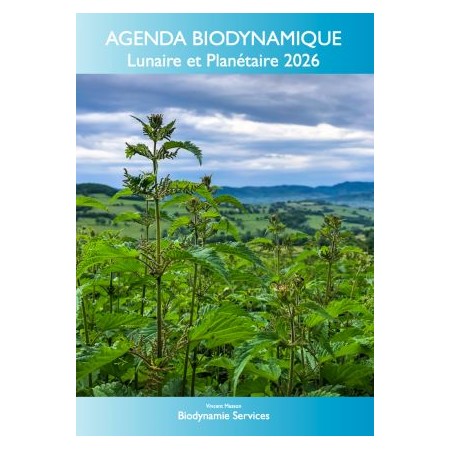


Agenda biodynamique lunaire et planétaire 2026
Agenda biodynamique lunaire et planétaire 2026 de Vincent Masson.
This calendar is not translated in english !
This calendar is not translated in english !
Biodynamic agriculture is based above all on the careful observation of nature. It invites the farmer to develop perception and judgement in order to intervene at the right moment, rather than following fixed recipes or a pre-established calendar.
As H. Spiess reminds us, decisions regarding soil work, sowing or fertilisation must primarily be guided by agronomic criteria, the condition of the soil, the plant’s needs and local weather conditions. Lunar and planetary rhythms can support this approach, but they remain secondary.
It is recommended to avoid sensitive work around lunar and planetary nodes and eclipses, but the essential point remains the understanding of living organisms: each plant must be able to harmoniously develop its roots, leaves, flowers and fruits, without attempting to artificially favour a single process.
Research on cosmic influences is still ongoing and sometimes yields contradictory results. Numerous factors — soil quality, seeds, weather, mastery of practices, and even the intuition sometimes called the farmer’s “green thumb” — influence outcomes.
The biodynamic calendar, when used with pragmatism, remains a valuable tool for organising work and improving the vitality, balance and quality of crops. The key lies in rigorous observation, in keeping precise notes throughout the tasks, and in exchanges between practitioners that help move biodynamics forward as a whole.
As in previous years, you will find indications such as tide coefficients, the various lunar and planetary positions, the opposition of the Moon and Saturn, viewpoints from different researchers, and so on.
The monthly right-hand pages are designed for a quick reading of the most important elements for everyday practice. To improve the readability of your agenda, we have included lunar and planetary nodes as shaded areas, and perigees, apogees and Moon–Saturn oppositions using different colours.
The favourable period for spraying Easter horsetail is shown as a green area on the April pages. The right-hand monthly page of January 2027 is included in the agenda to facilitate the transition to the following year. You will also find a few articles at the end of the book.
Lunar and planetary agenda by Vincent Masson. 44 pages, 21 × 29.7 cm, Biodynamie Services Publishing. July 2025.

- Number of pages
- Format
- Weight
feedback Report comment